










Bản quyền © 2026 ROTER Fresh Air Technology Wuxi Co., Ltd. Mọi quyền được bảo lưu. Website Design by Wangke
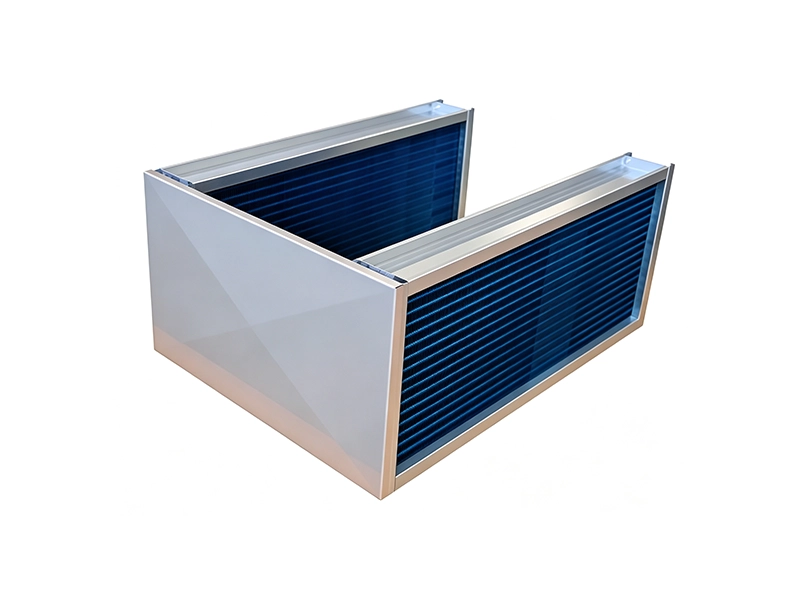
Bộ trao đổi nhiệt ống hút ẩm loại U
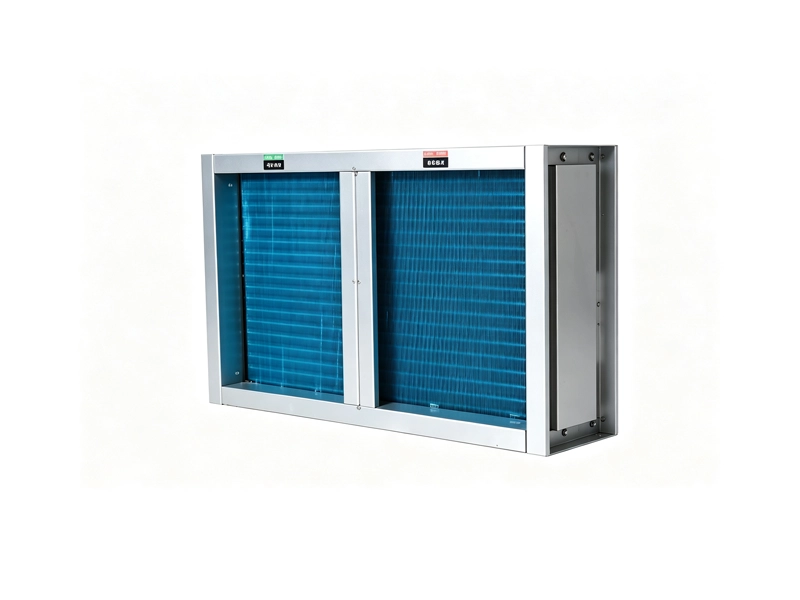
Bộ trao đổi nhiệt ống nhiệt
A heat pipe heat exchanger moves heat by phase change rather than by direct contact. Inside each sealed pipe a volatile liquid evaporates at the hot end and condenses at the cold end, carrying energy across a physical separation with nothing to leak and nothing to move. That gives three properties a ventilation system values: no moving parts, no water circuit to freeze or leak, and a long service life.
The gravity heat pipe heat exchanger generally adopts a gravity heat pipe configuration. When the hot end, the evaporator section, absorbs heat from the hot airflow passing through it, the high-saturation vapour generated by the volatile liquid inside the pipe flows towards the cold end, the condenser section. The cold airflow absorbs the heat released by the vapour and causes it to condense, and the resulting condensate returns to the evaporator section by gravity. This completes the evaporation-to-condensation cycle and, with it, the entire heat exchange process.
In the U-type dehumidification heat-pipe heat exchanger, both the evaporator section and the condenser section are arranged horizontally, positioned on the two sides of the air handling unit evaporator respectively, with the evaporator and condenser sections connected by copper tubes. This layout lets the unit handle both sensible and latent load, which is why it appears in air handling unit packages where the coil would otherwise be prone to icing.
| Requirement | Configuration | Reason |
|---|---|---|
| Recover heat from exhaust air in a ventilation system | Gravity heat pipe | Simple passive core with no condensate management needed |
| Dehumidify the air handling unit supply air | U-type | Evaporator and condenser sit either side of the AHU evaporator, handling latent load |
| Avoid any risk of water leakage into the duct | Either | The working fluid is sealed inside the pipe |
| Minimise maintenance after installation | Either | No moving parts and no consumable parts |
Heat pipe heat exchangers are used in ventilation and air conditioning systems wherever exhaust heat is worth recovering and condensate is not wanted in the supply air. They appear in hospital and laboratory ventilation, in commercial buildings with high exhaust loads, in industrial exhaust heat recovery, and inside air handling units where a heat pipe section replaces a finned coil that would otherwise need defrost controls.
Send the duty and the ROTER engineering team will confirm the core type, the section arrangement and the expected performance, with a dimensional drawing for installation.

Một doanh nghiệp dựa trên công nghệ chuyên nghiên cứu chất lượng không khí và sản xuất chuyên nghiệp các thiết bị thông gió tiết kiệm năng lượng và hiệu quả